Charles Cullen’s Guilty Plea
The Good Nurse: A True Story of Medicine, Madness, and MurderCharles Cullen’s guilty plea was both a legal reckoning and the beginning of a much larger accounting. In April 2004, after years of patient deaths obscured by hospital routines and incomplete records, he pleaded guilty to murders and attempted murders and agreed to cooperate with New Jersey prosecutors. The bargain spared him the death penalty but left investigators with years of cases to examine. His admission opened the door to that work without making his own version of events a reliable measure of its full scale.
From suspicion to a hidden pattern
At Saint Barnabas Hospital, the investigation began with patients whose blood contained exceptionally high levels of insulin, much of it foreign to their bodies. Two intravenous bags tested positive for insulin; microscopic examination found tiny needle punctures, including some along the edges, where accidental damage was not expected. Yet patient charts showed neither an insulin prescription nor a nursing notation that the drug had been administered. Security investigator Thomas Arnold and hospital vice president Joe Barry compared code times with staff schedules. Three nurses had been working every code, and Charles Cullen drew particular attention. When finally brought in for an interview, he refused to answer questions.
Cullen later gave Adrianne Cullen a different account of his departure from Saint Barnabas. He described the insulin incidents and investigation as a mystery, cast himself as a scapegoat for opposing a possible nurses’ strike, and presented his dismissal as retaliation for putting patients ahead of pay. The explanation made him the wronged subject of the story rather than its suspected perpetrator. Adrianne found the story difficult to make sense of, but let it stand. His account illustrates the distance between the suspicions that preceded the plea and the self-justifying narrative he offered to someone close to him.
The conduct behind the case
The evidence describes how ordinary nursing access could conceal extraordinary harm. At Saint Luke’s Hospital, Cullen injected digoxin into an elderly patient’s intravenous line, using a port through which nurses routinely flushed the line. Afterward, he put the vial and used needle in the sharps box, returned to the nurses’ station, and took a prominent role in the code when the patient’s condition collapsed. The same legitimate routines that made his presence appear unremarkable also gave him access to patients and opportunities to act without attracting immediate notice.
On another occasion, he chose a less direct method. While alone in the medication room, he used syringes to alter intravenous fluids and placed the prepared antibiotic mixtures in trays marked for patients. Coworkers saw him as helpful: he stocked medicines, assisted with lines, and participated in emergency responses. They did not connect those separate acts. Later, Amy Loughren reconsidered his customary position near the hallway doors. Cullen often met the pharmacy runner there, took the delivery tote, and stocked the unit. She realized that this route could give him access to drugs without using the Pyxis system at all. His work could look like assistance at each step while concealing the link between delivery, preparation, and patient crisis.
A confession shaped as a story
Before the plea, Cullen spoke for seven hours in an interrogation room, beginning at 6:15 on a Sunday evening and pausing for food, coffee, and bathroom breaks. He had kept no written list of his crimes and no mementos, and had never told anyone the full story aloud. But he had repeatedly revisited edited memories. In the room, he patiently reconstructed events, including the technical details of nursing, episodes of depression and suicide, and failed relationships. The account had a preferred shape: that of a misunderstood wanderer compelled to intervene benevolently.
His language preserved that self-image. Patients, in his telling, passed away, expired, or died; he intervened or felt compelled to intervene. He avoided describing himself as a killer and his acts as murder. The investigators had initially needed one patient account; Cullen gave them forty before the tape ran out. At 1:31 a.m. Monday, he stopped, leaving substantial matters unsaid. The confession was therefore not a complete inventory but a beginning: an extended narrative that investigators would have to check against records, and a performance in which admission coexisted with evasion.
The plea and its bargain
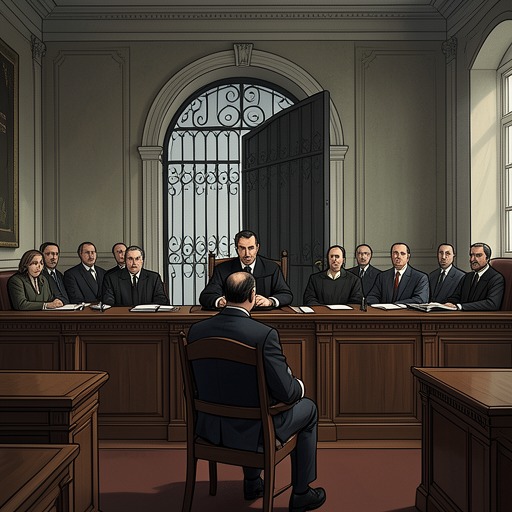
In April 2004, Cullen pleaded guilty in New Jersey court to thirteen murders and two attempted murders, offenses that made him eligible for the death penalty. He had told Amy Loughren and Somerset County investigators that he wanted to be put to death, but had not told his court-appointed lawyer, Johnnie Mask. The account distinguishes that stated wish from his underlying desire: his prior suicide attempts, the book says, had not truly been about dying. Cullen and Mask reached an agreement with prosecutors to remove the death penalty in exchange for his cooperation.
That cooperation became an extensive review of deaths across his hospital career. Investigators cross-referenced about 175 tips with work schedules, assignment sheets, Pyxis records, and Cerner transactions. Their initial list contained twenty-six high-probability victims from Cullen’s year at Somerset Medical Center alone. Cullen recognized some names but said he would need to review charts for the others. The subsequent work involved records from nine hospitals and sixteen years of deaths; detectives and lawyers brought new boxes of charts to him for review. The plea thus established legal responsibility for specific crimes while turning his knowledge into one investigative resource among many.
Consequences and limits
Cullen’s guilty plea did not settle the full number of people he had harmed. The postscript notes that, as of the book’s writing, he had been convicted of only one murder or attempted murder from his five years at Saint Barnabas, where he had also worked at eight other hospitals over the following eleven years. That limited conviction record contrasts with what investigators could establish at Somerset Medical Center, where sixteen murders were ultimately confirmed from the final six months of his career. The contrast underscores how much the answer depended on the completeness and accessibility of medical charts and drug data.
After the plea, Cullen’s life in Somerset County Jail acquired a regularity he had rarely known outside prison. He read spy novels, exercised, met with Catholic clergy, and was escorted to the prosecutor’s office to examine patient charts with investigators. The work continued for three years. His guilty plea was therefore not a final revelation that made every death legible; it was the hinge between a partial confession and a long, record-driven investigation. It converted his knowledge into evidence while leaving the scale of his crimes dependent on what the records—and further inquiry—could prove.